
Virtual vs. In-Person: Choosing the Right Conference Format
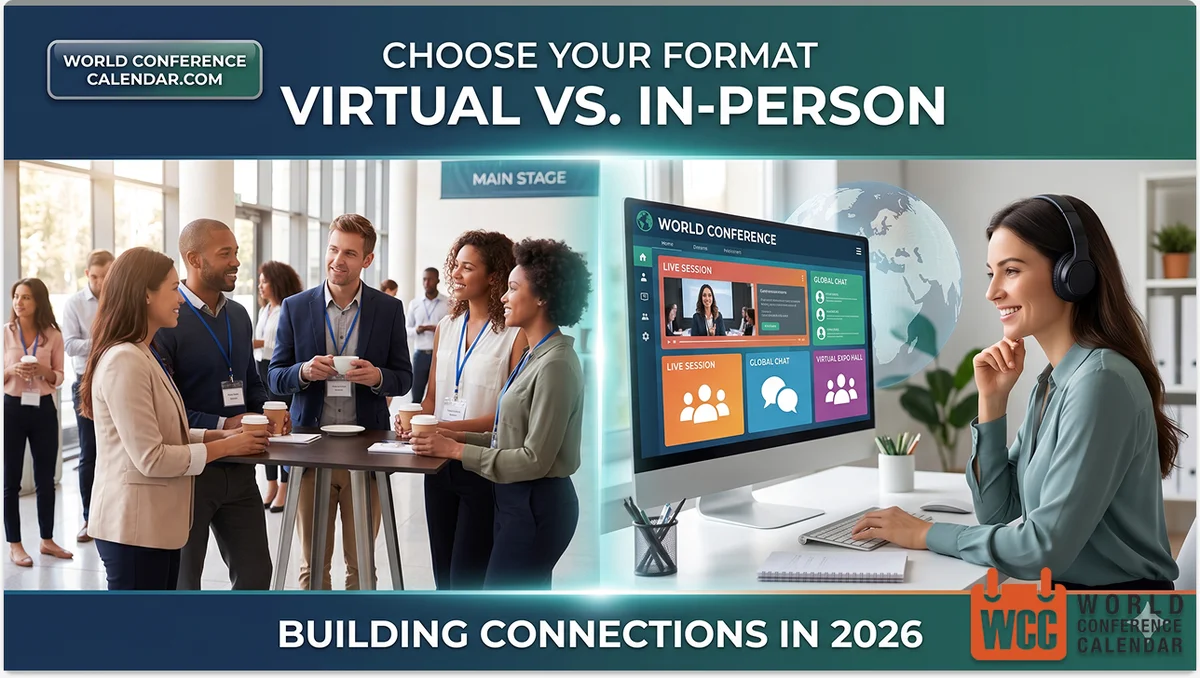
The landscape of professional gatherings has shifted dramatically. If you are planning an event for the 2026 season, you are no longer just choosing a city; you are choosing a medium. On WorldConferenceCalendar.com, we see thousands of organizers grappling with the same question: Should we meet in a physical hall or through a digital portal?
There is no "one-size-fits-all" answer. The right choice depends on your goals, your audience, and your budget. Here is how to break down the decision.
The Case for In-Person: The Power of Presence
In-person conferences remain the gold standard for high-stakes networking and relationship building. There is a "serendipity factor" in physical spaces—the chance meeting at the coffee station or the whispered insight during a breakout session—that technology hasn't quite replicated.
-
Best for: Trade shows, high-level leadership retreats, and industry-shifting networking events.
-
The Advantage: Human connection is at its peak. Behavioral data from 2026 shows that attendees are more likely to stay engaged for the duration of a session when they are physically in the room.
-
The Challenge: Logistics and cost. Between rising venue fees and the carbon footprint of international travel, physical events require a significant financial and environmental investment.
The Case for Virtual: Unmatched Scale and Efficiency
Virtual events have matured far beyond the "Zoom fatigue" era of years past. In 2026, top-tier virtual platforms use AI-driven matchmaking and immersive environments to keep audiences hooked.
-
Best for: Educational webinars, global summits, and software training.
-
The Advantage: Accessibility and ROI. Statistics indicate that virtual events are roughly 47% less expensive to produce than their physical counterparts. They allow you to reach a global audience without the barriers of visas, flights, or hotel costs.
-
The Challenge: Competing for attention. When your attendee is watching from their home office, you aren't just competing with other sessions—you’re competing with their inbox and their household distractions.
Comparison at a Glance
Feature In-Person Virtual
Reach Local/Regional Truly Global
Cost per Attendee High ($$$) Low ($)
Networking Spontaneous & Deep Structured & Data-Driven
Sustainability High Carbon Impact Eco-Friendly
Lead Generation High Quality/Face-to-Face High Volume/Data-Rich
The Middle Ground: The Hybrid Model
As we move through 2026, the Hybrid-First approach has become the industry standard. This involves hosting a core physical event while providing a "digital twin" for remote participants.
Hybrid events offer a safety net: if travel restrictions or budget cuts hit your attendees, they can simply pivot to the digital ticket. It also extends the life of your content; a recorded session from a live stage becomes a valuable digital asset for months to come.
How to Decide? Ask These Three Questions:
-
What is the primary goal? If it’s "closing deals," go in-person. If it’s "spreading knowledge," go virtual.
-
Where is your audience? If they are scattered across six continents, a virtual or hybrid component is no longer optional—it’s an expectation.
-
What is your budget? Be realistic. If you can’t afford a high-quality venue and catering, a high-production virtual event will always look more professional than a "cheap" in-person one.
Regardless of the format you choose, the most important element remains the content. Whether they are sitting in a velvet chair or a home office, your attendees are there to learn, grow, and connect. Focus on that, and your conference will be a success.
Ready to list your next event? Head over to our homepage to add your 2026 dates to the WorldConferenceCalendar.com database!