How to Choose the Right Academic Conference for Your Research
How to Choose the Right Academic Conference for Your Research
Choosing where to present your research is just as important as the research itself. Present the right paper to the wrong crowd, and your work risks falling flat. But place it in front of the right audience, and you unlock a world of valuable feedback, potential collaborations, and career-defining networking opportunities.
With thousands of events happening globally every year, finding the right home for your study can feel overwhelming. Here is a strategic guide on how to choose the right academic conference for your research and maximize your academic impact.
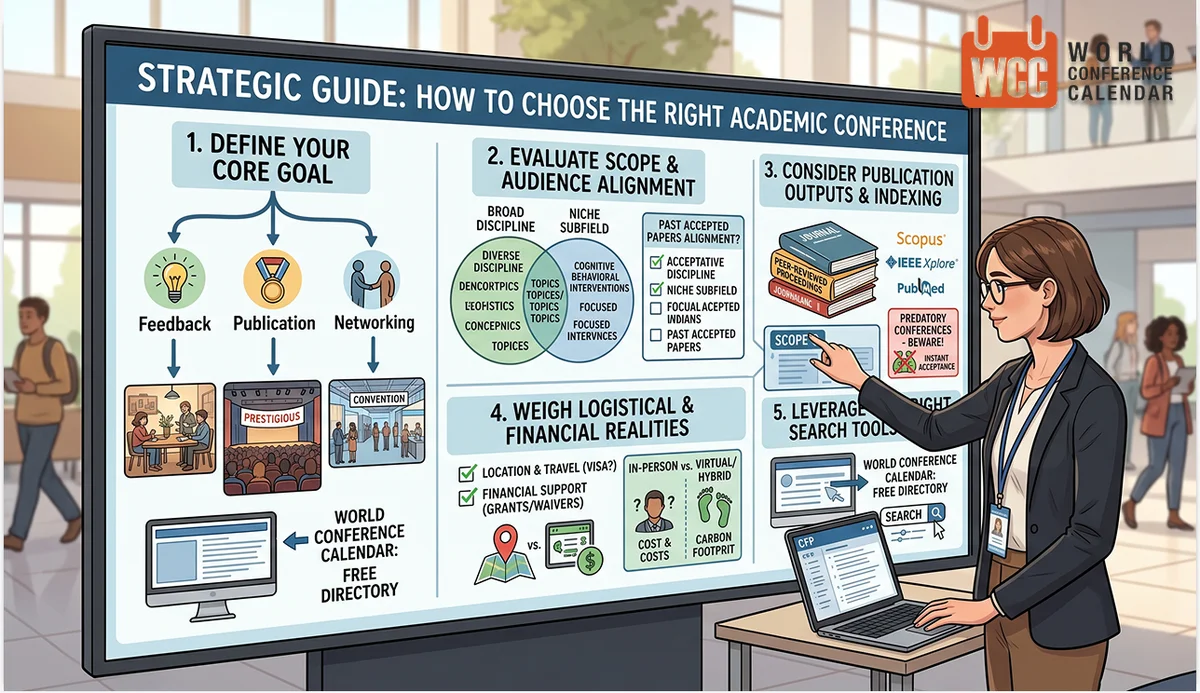
1. Define Your Core Goal
Before browsing call-for-papers (CFP) lists, ask yourself what you want to achieve. Different career stages and project phases align with different types of events:
- Seeking feedback on early-stage work? Look for smaller, niche workshops or regional symposiums. These environments are typically less intimidating and allow for deeper, more constructive discussions.
- Ready to publish a polished, high-impact study? Aim for top-tier national or international flagship conferences.
- Looking to expand your network or find a job? Broad, large-scale association conferences are excellent for visibility and career fairs, even if the session feedback is more generalized.
2. Evaluate Scope and Audience Alignment
A common mistake researchers make when trying to find a research conference is focusing solely on the prestige of the event rather than its scope. Look closely at the conference tracks and previous proceedings:
- Broad vs. Niche: A massive conference covers an entire discipline (e.g., the American Psychological Association annual convention), giving you a macro-level view of the field. A niche conference focuses strictly on a subfield (e.g., a conference dedicated entirely to cognitive behavioral interventions).
- The "So What?" Factor: Look at the past two or three years of accepted papers. Does your research methodology and theoretical framework align with what they traditionally publish? If your work is highly qualitative, submitting it to a heavily quantitative conference might result in a swift rejection or a mismatched audience.
3. Consider Publication Outputs and Indexing
In many disciplines—especially computer science, engineering, and medicine—conference proceedings are highly competitive and carry as much weight as journal publications.
If your goal is to build your CV for tenure or graduation, investigate how the conference handles submissions:
- Will your abstract or full paper be published in a peer-reviewed proceedings volume?
- Is the proceedings indexed in reputable databases like Scopus, IEEE Xplore, or PubMed?
- Does the conference partner with special issues of respected journals to publish expanded versions of top-tier presentations?
A Note on Predatory Conferences: The academic world is plagued by fake or low-quality "predatory" conferences designed solely to make a profit. Protect your work by avoiding events that promise instant acceptance, feature overly broad or disconnected topics (e.g., "Global Conference on Engineering, Business, and Health Sciences"), or lack a transparent peer-review process.
4. Weigh Logistical and Financial Realities
Let’s be practical: academic travel is expensive, and funding is often scarce. When choosing an academic conference, calculate the total investment required:
Factor
Key Considerations
Location & Travel
Is it international or domestic? Will you require a visa, and how long does that process take?
Financial Support
Does your university department provide travel grants? Does the conference itself offer student or early-career registration waivers?
Format
Is it in-person, fully virtual, or hybrid? Virtual conferences are highly cost-effective and accessible, though they require more intentional effort to network successfully.
5. Leverage the Right Search Tools
You don't have to rely purely on word-of-mouth to find your next event. There are dedicated academic aggregators and directories.
You may search on World Conference Calendar which is a free directory of academic conferences, workshops, and seminars from around the world.
Your Next Steps
Choosing the right academic conference is a balancing act between your career goals, the maturity of your data, and your available budget. Start your search at least six to nine months before your target presentation date to give yourself ample time to draft a compelling abstract, navigate the peer-review timeline, and secure funding.
By being intentional about where you send your work, you ensure that your research reaches the exact audience it needs to move the needle in your field.