
How to Write an Abstract That Gets Accepted: A Step-by-Step Guide for Conference Submitters
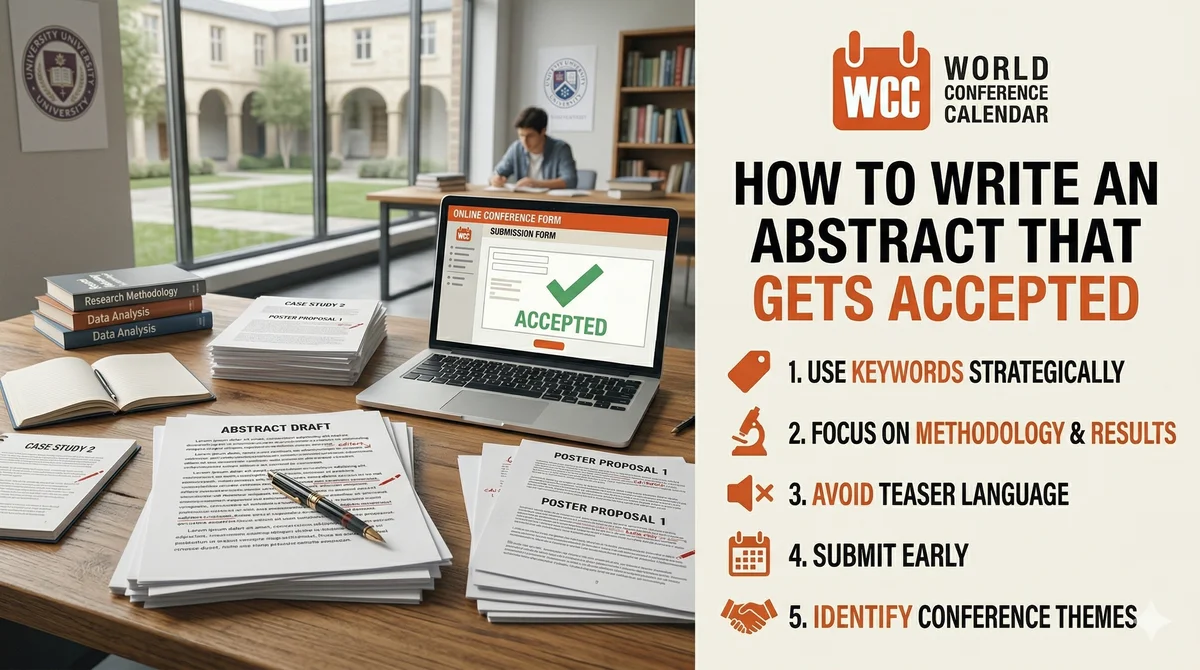
You’ve spent months, perhaps years, immersed in your research. You've analyzed the data, debated the findings, and now you have a conclusion worth sharing. The only hurdle standing between you and the stage at an international conference is a single, concise document: the abstract.
For conference reviewers, the abstract is your first impression. If it’s weak, vague, or poorly structured, your proposal will likely be rejected, regardless of the quality of your underlying work. Reviewers are often wading through hundreds of submissions and need to quickly identify the value of your contribution.
Here is a step-by-step guide on how to write a compelling, professional abstract that captures attention and gets that coveted "accepted" notification.
1. Understand the Purpose and Constraints
An abstract is not an introduction. It is not a teaser. It is a self-contained, miniature version of your entire project.
The Golden Rules of Abiding Constraints:
- Strictly Obey Word Count: If the limit is 300 words, provide 299, not 301. Automated systems may automatically disqualify entries that exceed the limit.
- Adhere to Format: Use the required font, spacing, and submission portal precisely.
- Identify the Audience: Tailor your language. An academic audience expects technical rigor; a broad industry audience requires a more accessible tone.
2. The Anatomy of a Winning Abstract (The Five Essential Parts)
To ensure clarity and logical flow, structure your abstract using these five components, dedicating approximately 1-2 sentences to each. Do not use headers; the flow should be seamless.
I. The Problem (The Context)
Why did you do this work? Start by establishing the context. Identify a gap in knowledge, a critical problem, or a current debate that your research addresses.
Example: "While the efficiency of solar cells has increased, current manufacturing methods are too energy-intensive for widespread adoption, creating a barrier to global sustainability goals."
II. The Objective (The Goal)
What did you set out to achieve? Clearly state your primary objective or research question. Use strong, active verbs.
Example: "This study investigated a novel, low-temperature deposition technique for producing flexible perovskite solar cells."
III. The Methodology (The Action)
How did you do it? Give a concise overview of your research design, methods, and experimental setup. Be specific enough that an expert in your field understands the approach. For case studies or implementation papers, describe the setting and the intervention.
Example: "A comparative analysis was performed on cells fabricated using standard spin-coating versus the new low-temperature technique. Performance was evaluated via X-ray diffraction, scanning electron microscopy, and standardized solar simulation tests."
IV. The Results (The Contribution)
What did you find? This is the most crucial part. Do not promise future results. You must present actual, specific data or qualitative findings. Be quantitative whenever possible.
Example: "The low-temperature process achieved a champion power conversion efficiency of 18.2%, comparable to the 19.1% achieved by standard methods. Crucially, the process reduced manufacturing energy consumption by 45%."
V. The Conclusion (The Impact)
So what? What are the primary implications of your results? Relate your findings back to the original problem and state how your work moves the field forward.
Example: "These findings establish low-temperature deposition as a viable strategy for cost-effective solar production, potentially accelerating the transition to renewable energy."
3. Insider Tips for the Competitive Edge
- Keywords are King: Identify the core themes of your research and list 4-6 essential keywords below your abstract. This helps reviewers find your work and ensures it is properly categorized.
- Write It Last: Complete your full project, data analysis, and main paper before writing the abstract. It's much easier to summarize something that is finished.
- Avoid "Teaser" Language: Never use phrases like "The implications will be discussed..." or "Future analysis will show..." You must show the analysis and discuss the implications in the abstract.
- The Title Matters: Create a clear, descriptive title that immediately signals what your research is about. A good title can often incorporate your main methodology or conclusion.
A well-crafted abstract is the key that unlocks your ability to present your work to a global audience. By following this structured approach, you turn an intimidating requirement into a concise advertisement for your expertise. Good luck with your next submission!